
Scientists Keep Finding Microplastics Inside Human Brains. Should We Be Worried?
The science behind how microscopic polymers enter our bodies, and what researchers actually know about the risks.

Not long ago, the idea that tiny pieces of plastic could end up inside the human brain would have sounded like the plot of a dystopian novel. Plastic was something we worried about in oceans, rivers, or overflowing landfills—not in the organ that controls our thoughts, memories, and personalities.
Then the studies started appearing.
One research group after another began reporting the same surprising finding: microscopic plastic particles had been detected in donated human brain tissue. In some cases, researchers even estimated that the brain contained higher concentrations than several other organs.
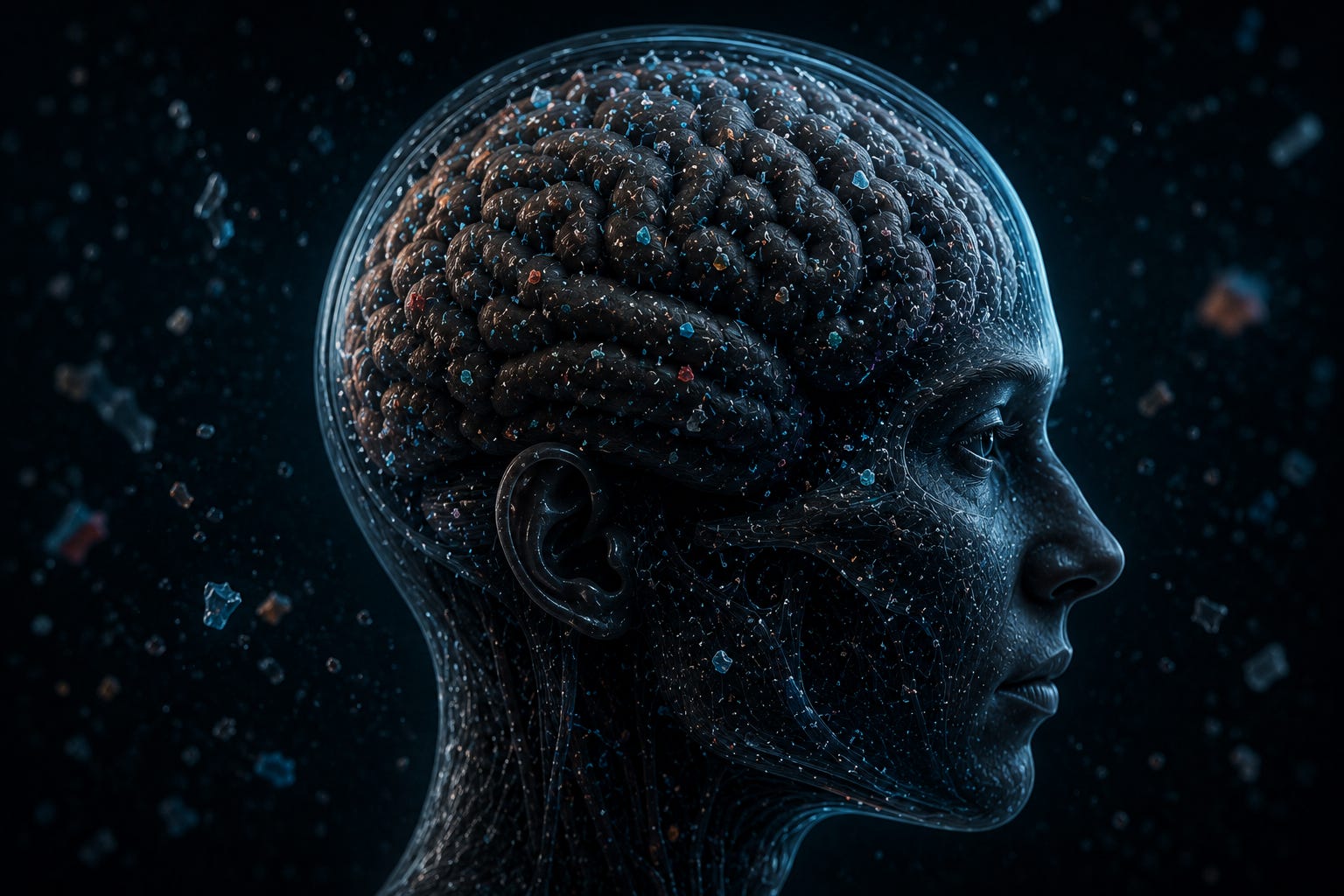
It’s the kind of discovery that almost writes its own headlines. Plastic found in human brains. It’s unsettling, easy to understand, and impossible to ignore.
But it’s also a perfect example of why science is often more complicated than the headlines that summarize it.
Before asking whether these tiny fragments are dangerous, it’s worth taking a step back and asking a simpler question: how could they end up there in the first place?
The answer begins with a realization that’s both fascinating and a little uncomfortable. Plastic has become so deeply woven into modern life that we’re surrounded by it almost every moment of the day.
Over time, larger pieces of plastic don’t simply disappear. Sunlight, friction, heat, and weather slowly break them into smaller and smaller fragments. Some are still visible to the naked eye, while others become so tiny they can only be detected with sophisticated laboratory equipment. These are what scientists call microplastics, and the very smallest among them are known as nanoplastics.
Researchers have found them almost everywhere they’ve looked: in oceans, mountain snow, rainwater, drinking water, seafood, fruits and vegetables, and even the air inside our homes. Tiny fibers are shed from synthetic clothing, microscopic particles wear off car tires, and plastic packaging slowly degrades over time. At this point, avoiding exposure entirely is probably impossible.

That also explains how these particles enter our bodies. Some are swallowed with food or water, while others are inhaled without us ever noticing. Our bodies are remarkably good at getting rid of many larger particles, but scientists are particularly interested in the smallest ones because they may travel farther than previously thought.
Over the past few years, researchers have begun examining donated human tissues using analytical techniques far more sensitive than anything available just a decade ago. Those methods can distinguish different plastics from normal biological material, allowing scientists to identify common polymers such as polyethylene—the plastic used in many shopping bags and food containers.
The brain wasn’t the first place they found them.
Before that, researchers had already detected microplastics in blood, lungs, the liver, kidneys, the placenta, and several other tissues. Each discovery suggested that these particles were capable of traveling throughout the body. Still, finding them in the brain felt different.
After all, the brain is protected by one of the body’s most sophisticated defense systems: the blood-brain barrier. It’s a highly selective filter that allows nutrients to pass through while blocking many harmful substances. So if plastic particles are making it into the brain, how are they getting past those defenses?
The honest answer is that scientists don’t fully know yet.
Some laboratory studies suggest that extremely small particles may pass through cells directly or hitch a ride inside immune cells. Others may enter the bloodstream through the lungs or digestive system before eventually reaching the brain. Researchers are still investigating exactly how often this happens and which mechanisms are involved.
If that uncertainty sounds frustrating, it’s actually a normal part of science.
For years, researchers simply didn’t have instruments sensitive enough to detect these tiny particles reliably. It’s entirely possible that microplastics have been present in human tissues for much longer than we realize. What’s changed isn’t necessarily the biology—it’s our ability to observe it.
Of course, once the words plastic and brain appeared together, the headlines practically wrote themselves.
But here’s the important part: the studies making those headlines were designed to answer one question above all others.
Are plastic particles present?
The answer appears to be yes.
What they were not designed to answer is whether those particles are actually causing harm.
Those are two very different scientific questions.
Finding something inside the body doesn’t automatically mean it’s dangerous. The real challenge is figuring out whether those particles interfere with normal biology, increase disease risk, or simply exist without causing measurable damage. Answering those questions requires years of additional research.
That’s made even harder by the fact that “microplastics” isn’t a single material. The term covers thousands of different particles that vary in size, shape, chemical composition, and the additives used during manufacturing. Studying their health effects is far more complicated than studying a single chemical.
So where does that leave us?
Scientists are increasingly confident that humans are exposed to microplastics every day and that at least some of those particles make their way into different organs, including the brain. Beyond that, many of the biggest questions remain unanswered.
Do these particles accumulate over time? Can the body remove them? Are some plastics more concerning than others? And perhaps most importantly, do they actually affect how the brain works?
Those answers will take time.
The discovery of microplastics in the human brain is scientifically important because it tells us something new about the world we live in. But it’s only the beginning of the story—not the end of it.
Finding something isn’t the same as proving it’s harmful.
Thank you for reading! In Thursday’s article, we’ll tackle the question everyone really wants answered: can microplastics actually damage your brain? We’ll dig into what the evidence says about the blood-brain barrier, inflammation, toxicology, animal experiments, and human studies to separate genuine scientific concerns from sensational headlines. See you then.
It might explain the Reverse Flynn Effect.
https://www.develop.bc.ca/the-reverse-flynn-effect/
They are spraying something in the air!