
Blood: The Hidden Civilization Inside You
Trillions of specialized cells work together with astonishing precision every second, yet most of us never stop to think about them.

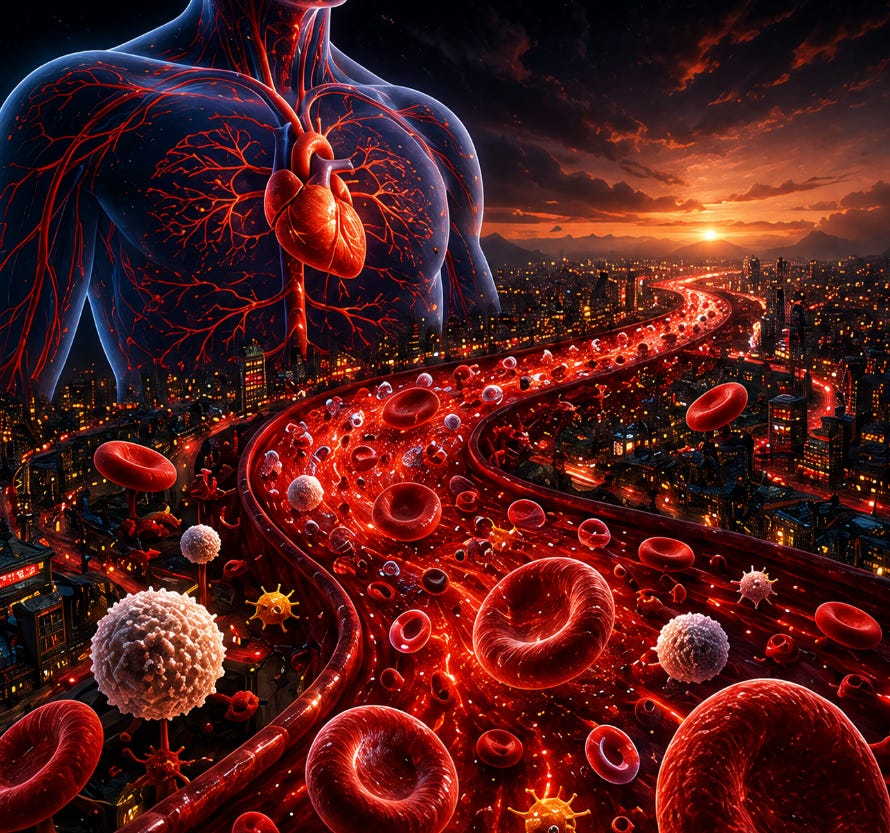
Last Monday we laughed at blood.
Red blood cells were portrayed as frantic commuters, platelets as exhausted construction workers, and AB+ blood cheerfully insisted that “blood is blood.” Like all good memes, they were funny because they exaggerated something that already contained a grain of truth.
The more I thought about those jokes, the more one question kept coming back to me.
Why do blood memes work so well?
The answer surprised me. It’s because blood almost feels alive in a way we don’t usually associate with a liquid. We instinctively imagine red blood cells having personalities because, in a sense, blood behaves less like a fluid and more like a bustling society.
That’s strange, because blood is also one of the most overlooked parts of our bodies.
Ask someone to name the body’s most important structures and they’ll probably mention the brain, the heart, or the lungs. Blood rarely makes the list. We treat it as little more than the red liquid connecting everything else.
But perhaps we’ve had it backwards all along.
The Body’s Greatest Logistics Company
Most people know blood carries oxygen.
That fact is taught so early in school that it almost feels like the entire story. But saying blood carries oxygen is a bit like saying the internet sends emails. It’s technically correct, yet it misses almost everything that makes the system remarkable.
Blood is simultaneously a transportation network, postal service, heating system, waste disposal service, emergency repair crew, food delivery network, and military defense force.
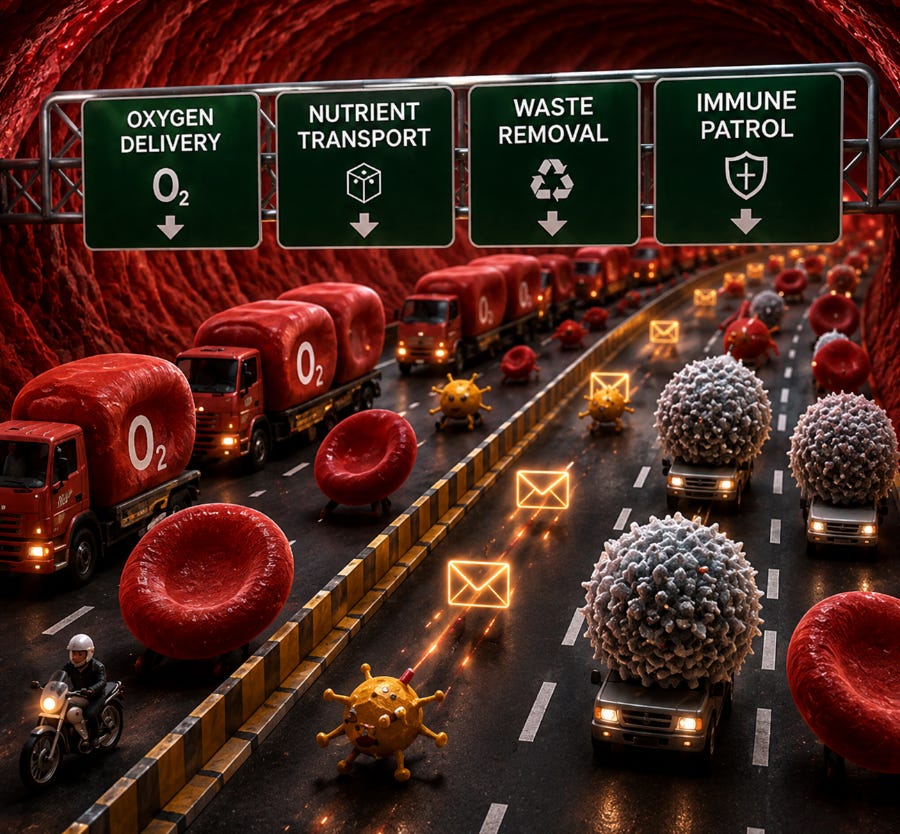
Every heartbeat sends oxygen to your brain, nutrients to your muscles, hormones to distant organs, immune cells toward potential threats, and waste products back to the kidneys and liver for disposal. It even redistributes heat, helping keep your body temperature remarkably stable despite changing conditions.
None of your organs communicate directly. Your thyroid never calls your kidneys. Your pancreas doesn’t send emails to your muscles.
Instead, they all communicate through blood.
Every second, countless microscopic messages are delivered with astonishing reliability. Blood isn’t merely flowing—it is coordinating your entire body.
A City Without a Mayor
One of the most fascinating things about blood is that nobody is in charge.
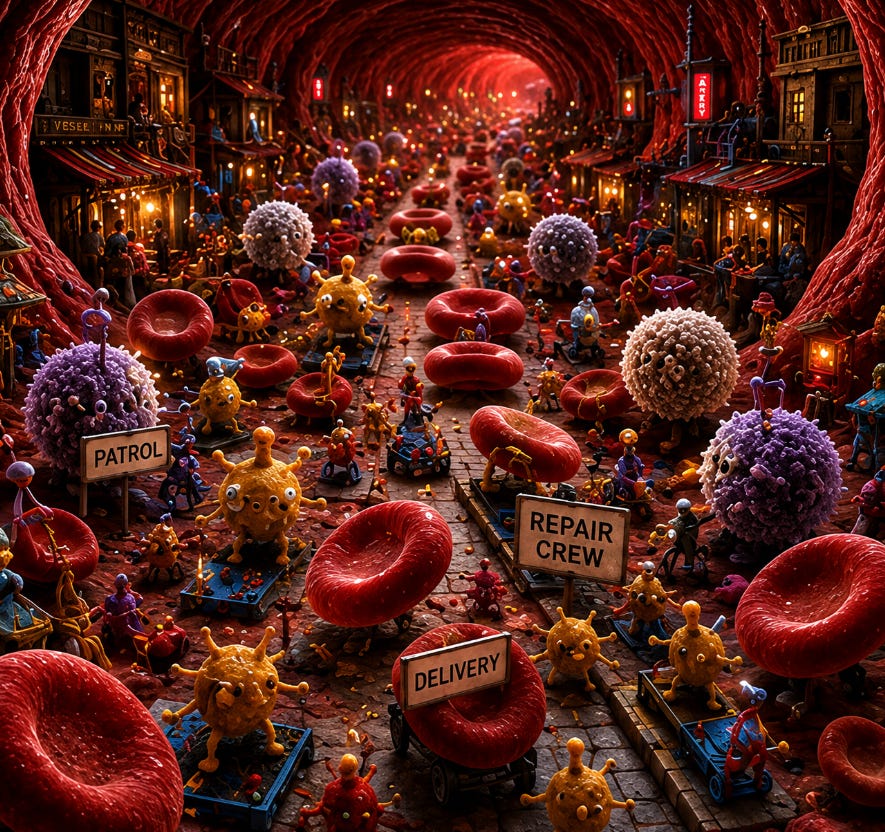
There is no dispatcher assigning platelets to injuries. No traffic controller directing red blood cells through capillaries. No central computer telling immune cells which bacteria to attack.
Yet everything somehow works.
Platelets drift quietly through the bloodstream until a blood vessel is damaged. Within seconds they recognize exposed tissue, become sticky, release chemical signals, recruit additional platelets, and begin building a clot.
White blood cells perform an equally extraordinary task. They constantly inspect cells they encounter, distinguishing friend from foe with astonishing accuracy. Some even remember viruses and bacteria they encountered years—or decades—earlier, allowing your immune system to respond far more quickly the next time those invaders appear.
Even red blood cells display remarkable engineering. Many capillaries are narrower than the cells themselves, forcing them to fold, twist, and squeeze through spaces that initially seem impossible before springing back into shape.
It resembles a city where millions of workers know exactly what to do despite never receiving instructions.
Numbers That Barely Feel Real
The scale of blood is almost impossible to visualize.
Right now, roughly 25 trillion red blood cells are circulating through your body. Every second, your bone marrow quietly manufactures around 2 million new ones to replace those reaching the end of their lives.
Each individual red blood cell survives for about 120 days, traveling roughly 250 kilometers (155 miles) during its lifetime.
Even a single drop of blood contains millions of cells.
Perhaps most astonishing of all, if every blood vessel in your body were connected end to end, they would stretch roughly 100,000 kilometers (62,000 miles)—enough to circle Earth more than twice.
Without realizing it, every one of us carries a planetary-scale transportation network inside our bodies.
YOUR BLOOD
❤️ ~25 trillion red blood cells
🩸 2 million created every second
🌍 100,000 km of blood vessels
🫁 ~120-day lifespan
🔄 Iron is recycled
🚚 Billions of deliveries every heartbeat
The Life of a Single Red Blood Cell
Imagine being born with only one purpose.
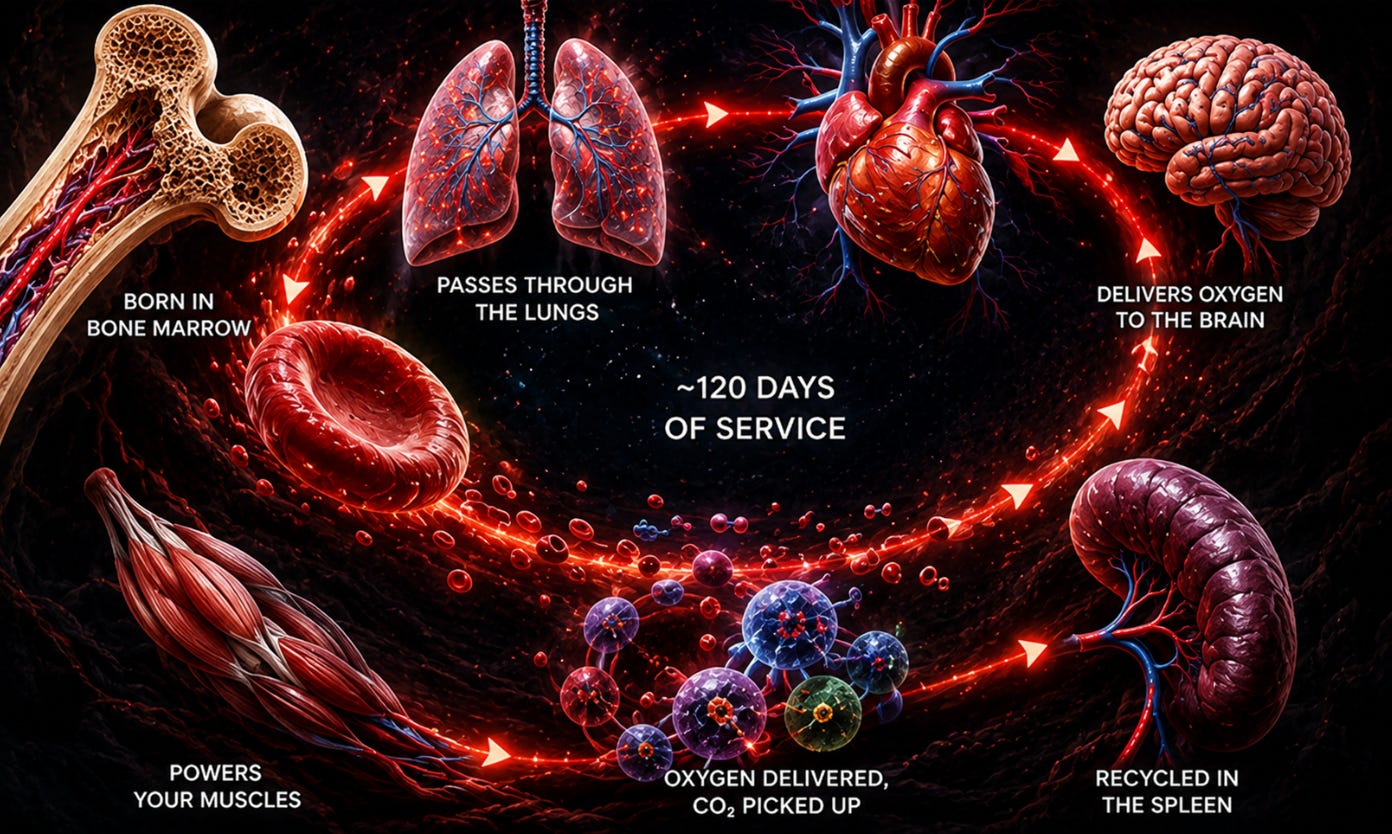
Deep inside your bone marrow, a stem cell begins transforming into a future red blood cell. As it matures, it fills itself with hemoglobin, the iron-containing protein responsible for carrying oxygen.
Then something extraordinary happens.
Unlike almost every other cell in your body, it throws away its nucleus.
Losing its DNA means it will never divide or repair itself again. But the sacrifice creates additional room for hemoglobin, allowing it to transport more oxygen during every journey.
For the next four months, it becomes one of the hardest-working cells in your body.
Every circuit carries oxygen from the lungs to tissues throughout your body before returning for another load. It repeats this journey hundreds of thousands of times without pause.
Eventually, age catches up with it. The once-flexible cell becomes stiff, making it difficult to squeeze through tiny capillaries.
The spleen notices.
The cell is dismantled, its components recycled, and even its iron is carefully recovered to build the next generation.
Nature wastes almost nothing.
Evolution’s Clever Tricks
Red blood cells look deceptively simple, yet almost every feature has been refined through millions of years of evolution.
Their familiar disc-like shape increases surface area, allowing oxygen to move in and out efficiently while also making the cells remarkably flexible.
Discarding the nucleus creates additional space for hemoglobin, dramatically increasing oxygen-carrying capacity.
Blood itself owes its color to iron inside hemoglobin. Oxygen-rich blood appears bright red, while oxygen-poor blood becomes a darker shade—but never blue.
The blue appearance of veins is simply an optical illusion created by the way skin absorbs and scatters light.
Sometimes biology’s strangest mysteries are solved not by biology alone, but by physics.
When the Balance Breaks
Systems this sophisticated don’t require catastrophic failure to cause serious disease.
If too little hemoglobin is available, tissues receive less oxygen and anemia develops.
If clotting occurs too readily, dangerous blockages can form inside blood vessels. If clotting is insufficient, even relatively minor injuries become difficult to stop.
Leukemia transforms the very white blood cells meant to defend us into cancerous cells that crowd out healthy blood production.
And in sepsis, the immune system’s attempt to eliminate infection becomes so overwhelming that it begins damaging the body’s own organs.
These diseases remind us how delicately balanced blood really is. Every component depends on every other component functioning at precisely the right time.
The Miracle You Never Notice
Your heart beats roughly 100,000 times every day.
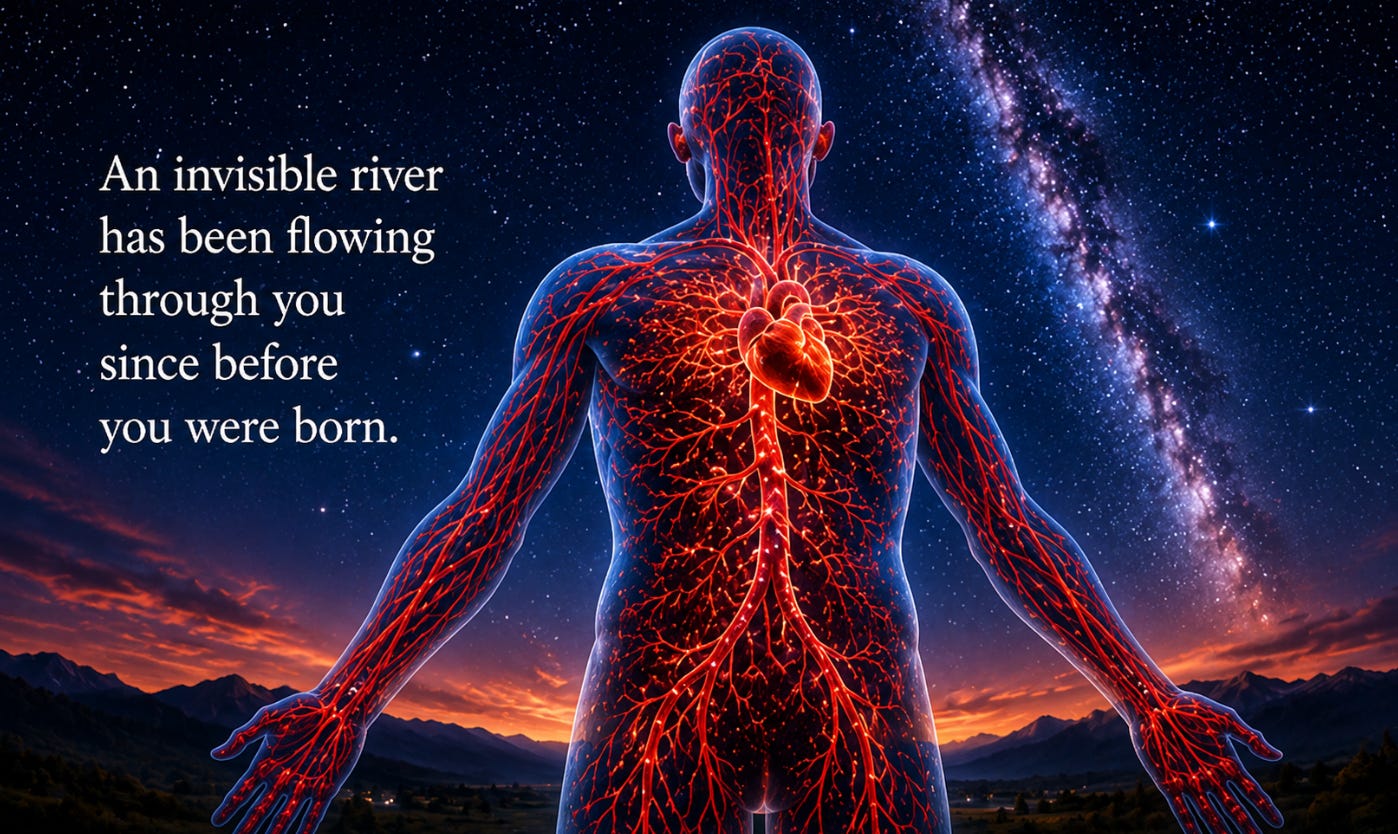
With each beat, billions of blood cells begin another journey. Some deliver oxygen. Others carry hormones. Some patrol for infection. Others remove waste or stand ready to repair damaged vessels.
You never notice them.
That may be blood’s greatest achievement.
The most remarkable systems in life are often invisible when they work well. Electricity disappears when the lights stay on. The internet fades into the background when every webpage loads instantly.
Blood belongs in the same category.
We rarely think about it, not because it is ordinary, but because it performs its astonishing work with extraordinary reliability.
Perhaps that’s why blood became such fertile ground for memes.
The jokes imagine blood cells as tiny workers with personalities because, viewed from the right perspective, that’s not entirely wrong. Your bloodstream really is home to trillions of specialized cells, each performing a specific role in an unimaginably complex system.
The memes made us laugh.
The science reveals something even more satisfying.
For your entire life, an invisible river has been flowing through you, carrying not just oxygen, but the quiet machinery that makes every heartbeat, every thought, every movement, and every breath possible.
And perhaps that’s the best part of science.
The closer you look, the stranger and more beautiful ordinary things become.
🩸 This Saturday for members
This article barely scratches the surface.
In this week’s Weekend Deep Dive, we’ll explore five of the biggest myths about blood—including whether veins are really blue, whether people with Type O blood are universal donors in every situation, why “blood is thicker than water” is scientifically misleading, and several other misconceptions that almost everyone has heard.
If you’ve enjoyed today’s journey, becoming a member helps me keep these free articles coming every week—and gives you access to a new deep dive every Saturday.
UPDATE: Here is the link to the Saturday’s article: Things You Thought You Knew About Blood
I’d love to have you there.
Sounds a little bit too much AI-generated for my taste... guess I'll cancel the abo